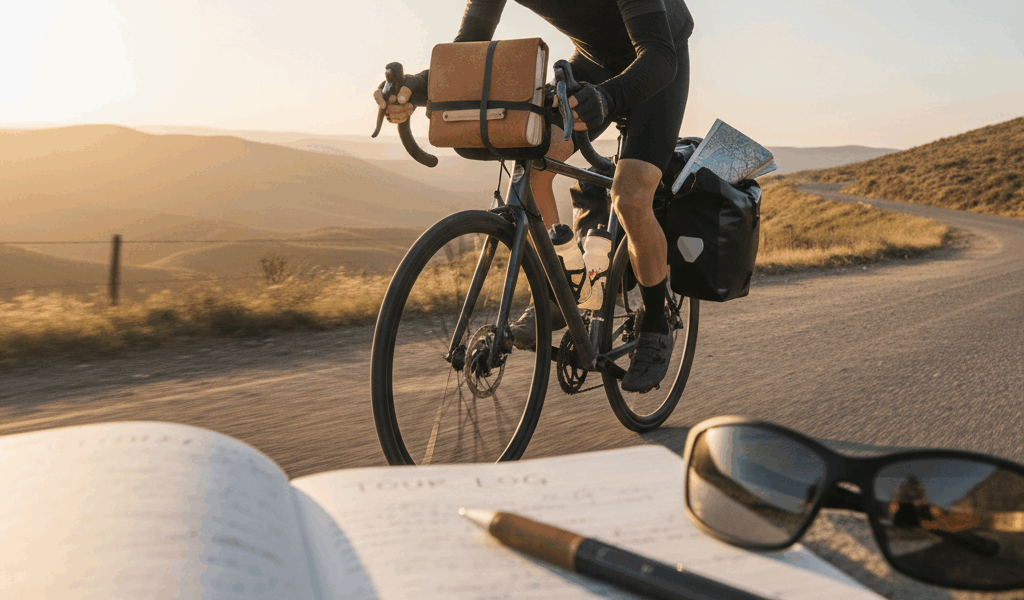
Strava has 125 million users. Ride with GPS has detailed route analytics. Every bike computer syncs to the cloud. Yet there’s a quiet rebellion happening among long-distance cyclists: they’re ditching the apps and returning to paper journals.
Not as a nostalgic gimmick. As a deliberate choice that changes how they experience bikepacking.
The Digital Burnout Is Real
After a 2,700-mile TransAmerica Trail ride, one bikepacker summarized it perfectly: “I can’t remember any of it. I have 4,000 photos and 47 Strava rides, but I couldn’t tell you what I was thinking on day 23.”
This is the paradox of digital documentation: we capture everything and remember nothing.
What Digital Tracking Actually Records
- Distance: 78.3 miles
- Elevation gain: 4,127 feet
- Average speed: 11.2 mph
- Heart rate zones: 3:42 in Zone 2
What a Paper Journal Records
- “My legs felt like concrete after yesterday’s climb”
- “Met a rancher who let me fill water bottles at his barn”
- “Thunderstorm forced me under a highway overpass for 2 hours”
- “Saw the Milky Way for the first time in 15 years”
One captures data. The other captures experience.
Why Long-Distance Cyclists Are Switching Back
1. No Battery Anxiety
Your bike computer dies. Your phone is at 12%. Your power bank ran out yesterday. But your journal works with a $0.50 pencil stub—no charging required.
On the Great Divide Mountain Bike Route, where you might go 100+ miles between electrical outlets, battery independence matters.
2. Camp Ritual That Actually Relaxes
After setting up your tent and cooking dinner, you have a choice:
- Scroll social media while your photos upload to Strava (stress, comparison, FOMO)
- Write in your journal about what you saw and felt today (reflection, processing, decompression)
Digital engagement keeps you in performance mode. Journaling switches you into recovery mode.
3. Memory Formation Through Writing
Neuroscience research shows that handwriting activates brain regions involved in memory consolidation that typing doesn’t engage. When you physically write “climbed 6,000 feet to Monarch Pass, saw 14 elk at sunrise,” your brain encodes it differently than tapping upload on a Strava ride.
This is why ultra-endurance athletes increasingly journal: they want to remember the experience, not just the stats.
4. Privacy From The Algorithm
Every ride you log, every photo you post, every route you save becomes data that companies monetize. Your journal stays offline, untracked, and uncommercial.
For cyclists burned out on the constant documentation-for-validation cycle, a paper journal feels like reclaiming ownership of their experiences.
What Experienced Bikepackers Actually Journal
This isn’t flowery prose or elaborate sketching. It’s functional documentation:
Daily Template (5-10 minutes per day)
- Route: “Day 17: Salida to Monarch Pass, 42 miles”
- Weather: “Clear morning, thunderstorm 2-4pm, cold at altitude”
- Body status: “Left knee sore, right shoulder still tight”
- Gear notes: “Rear brake pads need replacing soon”
- One memorable moment: The thing you’d forget if you didn’t write it down
- Tomorrow’s plan: “Descend to Gunnison, resupply at City Market”
Practical Benefits Beyond Nostalgia
Six months after your trip, you want to recommend the route to a friend. With digital logs, you remember “day 12 was hard.” With journal entries, you can tell them: “Don’t camp at mile 340—exposed ridgeline with no wind protection. Push 6 more miles to the creek at mile 346.”
The journal becomes a reference guide, not just a memoir.
The Best Bikepacking Journals (Tested)
Rite in the Rain All-Weather Notebook
Weight: 60 grams
Why it works: Waterproof paper, durable cover, writes even when wet
Best for: Serious weather exposure, multiple-week trips
Field Notes Expedition Edition
Weight: 35 grams
Why it works: Compact, tough covers, grid pages for sketching routes
Best for: Minimalist bikepackers, weekend trips
Moleskine Cahier Soft Cover
Weight: 45 grams
Why it works: Flexible cover fits in jersey pocket, inexpensive
Best for: First-time journalers, fair-weather rides
DIY Ultralight Option
Weight: 15 grams
What it is: 30 sheets of paper folded in half, binder-clipped
Why it works: Absurdly lightweight, replaceable pages
Best for: Weight-obsessed gram counters
Common Objections (And Why They Don’t Hold Up)
“I need my digital data for training analysis”
Bring both. Let your bike computer record the metrics. Use the journal for what matters beyond watts and heart rate.
“I’m not a good writer”
You’re not publishing a memoir. “Hot day. Headwind sucked. Great sunset.” is a perfectly valid journal entry that you’ll appreciate reading 5 years later.
“It’s extra weight”
A field notebook weighs 35-60 grams. A mini pencil weighs 3 grams. Your phone weighs 200+ grams and you’re carrying that anyway.
“I’ll just forget to do it”
Make it part of your camp setup routine: tent, sleep pad, journal. It takes 5 minutes and becomes automatic within 3 days.
The Hybrid Approach That Works
You don’t have to choose between analog and digital. Most long-distance cyclists use both:
- Bike computer: Records route, distance, elevation (syncs when you have service)
- Phone: Takes photos, navigation backup
- Journal: Daily reflection, gear notes, memorable moments
Digital captures the what. The journal captures the why.
What Happens When You Journal
The real value reveals itself months later. You’re planning next year’s trip. You open your journal from last year’s Colorado Trail ride:
“Day 9: Started from Molas Pass. Beautiful but brutal climb to Rolling Mountain Pass. Saw mountain goats at 12,500′. Water source at mile 18 was dry—had to detour 2 miles down to creek. Don’t plan to camp at Celebration Lake—too exposed and cold at altitude. Made it to Hotel Draw, much better. Knee feeling better after rest day.”
Try getting that level of useful detail from a Strava file.
The Uncomfortable Truth About Digital Logging
Apps and devices make it easy to track everything. But tracking isn’t the same as remembering. Recording isn’t the same as experiencing.
When you’re 40 miles into a headwind, grinding through gravel, questioning why you’re doing this—that’s when a journal matters. Not to capture data, but to process the moment.
That night in your tent, you write: “Today was hard. My legs hurt. I wanted to quit at mile 25. But then I came over that ridge and saw the valley spread out below, and I remembered why I’m out here.”
No Strava ride summary will ever capture that.
Start Simple
You don’t need a perfect system. Just pack a small notebook and a pencil on your next overnight ride. Write three sentences before you fall asleep:
- Where you went
- How it felt
- One thing you noticed
Do that for 3 days. Then read what you wrote.
You’ll understand why paper journals are making a comeback.