Numb Hands on Long Rides — Fixes That Actually Work
Hand numbness on long rides has gotten complicated with all the conflicting advice flying around. Everyone’s got a forum post, a product recommendation, a stretching routine. I learned everything there is to know about this problem the hard way — day four of my TransAmerica attempt, somewhere before Montana, waking up with fingers so dead I couldn’t unzip my tent. Not tingly. Not “a little stiff.” Actually numb, like I’d slept on both arms at once. I spent the next 2,800 miles figuring out what actually fixed it. Here’s what I found — and the single most important thing is something most advice skips entirely: which fingers go numb tells you exactly what’s wrong.
Which Fingers Are Numb Tells You the Cause
Probably should have opened with this section, honestly. Everything else — the fit changes, the gloves, the handlebar swaps — only works if you match the fix to the actual nerve being compressed. Get this wrong and you’ll spend $80 on ergonomic grips that solve nothing.
But what are we actually dealing with here? In essence, it’s two nerves doing two very different jobs. But it’s much more than that — they compress in different spots, under different loads, for entirely different reasons. The ulnar nerve runs along the outside of your wrist and feeds your ring finger and pinky. The median nerve runs through the carpal tunnel and covers your thumb, index finger, and middle finger.
Ring Finger and Pinky — Ulnar Nerve Compression
This was my problem. Ring and pinky going numb usually means your hypothenar eminence — that fleshy pad on the outside of your palm below the pinky — is taking sustained direct pressure against the grip or bar. On flat bars, this happens when you ride with your palms flat and your weight pushed forward. On drop bars, it tends to happen in the hoods position, especially if your reach is long and your wrists are cocked slightly inward.
Ulnar nerve compression is more common in touring setups because loaded bikes push you into a forward-heavy position. The heavier your front panniers, the worse it gets. That’s what makes this particular nerve problem so endearing to us touring riders — it’s baked right into the setup most of us run.
Thumb, Index, Middle — Median Nerve Compression
Numbness in the thumb, index, and middle fingers is median nerve territory. Classic cyclist’s palsy — same nerve as carpal tunnel syndrome. The compression point is the base of the palm, right at the carpal tunnel, and it tends to worsen across consecutive days as inflammation quietly builds up in the tunnel itself.
Riders with a very upright position sometimes develop this because they’re gripping harder to control the bike. More often, it’s a drop-bar rider spending too long on the tops without enough padding under the heel of the hand.
Knowing which nerve you’re dealing with changes everything. If your pinky is numb, padding the outside edge of your palm matters. If your thumb is numb, padding the base-center of your palm matters. These are not the same place. A glove that fixes one can make the other worse. Don’t make my mistake — I bought two pairs of gloves before I understood this.
Handlebar Position and Bike Fit Fixes
Frustrated by four consecutive mornings of wooden fingers, I rolled into a bike shop in Pueblo, Colorado using my palms flat on the bars because gripping hurt. The mechanic watched me sit on the bike for maybe thirty seconds, arms out, spine flat, and said, “You’re basically doing a plank on this thing.”
He was right. My reach was too long, my bars too low. Both problems were dumping weight onto my hands that my core should have been supporting.
Bar Height — Raise It
Raising your bars reduces the angle your torso makes with the bike, which shifts weight back toward your sit bones. For touring, this matters enormously — you’re not racing, you’re covering distance over consecutive days, and fatigue accumulates. A 10 to 15mm rise in bar height can take a meaningful chunk of weight off your hands without meaningfully affecting your aerodynamics on a loaded bike.
On a threadless stem, this usually means flipping the stem or adding a riser spacer. My setup went from a 6-degree drop stem to a 17-degree rise stem — a Surly 90mm unit for around $35. That change alone reduced my numbness by maybe 60 percent. Cheap fix, dramatic result.
Stem Length — Shorten It
Long reach means you’re stretching out, locking your elbows, transmitting road vibration directly into your wrists with nothing absorbing it. Shortening the stem by 10mm lets your elbows bend slightly — a natural shock absorber. It also shifts your weight slightly rearward.
Combined with raising the bars, shortening the stem is the highest-leverage fit change you can make. These two things together took me from waking up with numb hands every single morning to waking up with numb hands maybe once a week, and only after brutally long days.
Saddle Tilt — An Underrated Factor
A nose-down saddle tilt makes you slide forward constantly, which means you’re propping yourself up with your hands all day. Even 2 degrees of nose-down tilt is enough to cause this over a hundred-mile day. Level saddle or very slightly nose-up. Check it with a straight edge or a phone level app. Apparently this is one of those things everyone knows and nobody actually does.
Grips, Gloves, and Bar Tape That Help
Here’s where the ulnar versus median distinction matters in a very concrete, money-spending way.
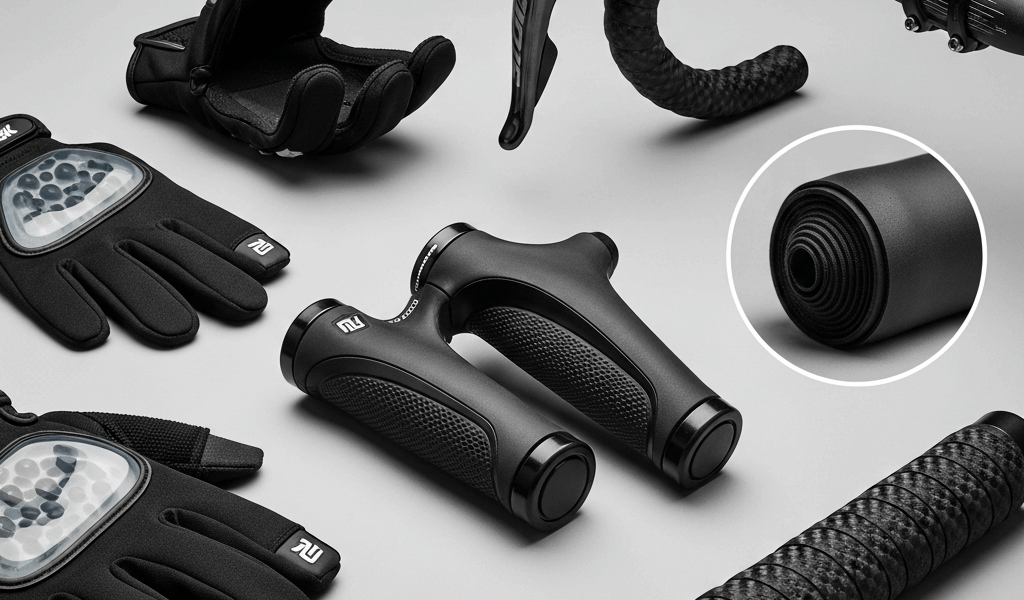
Flat Bar Grips — Ergon GP Series
Ergon GP1 grips — around $40 at most bike shops — have a wing-shaped flare on the outside of the grip that distributes pressure across more of your palm. The wing shape specifically offloads the hypothenar eminence, that outside pad where ulnar nerve compression happens. If your ring and pinky are going numb, these grips are not a maybe. They’re the answer for flat bar bikes.
The GP3 version ($55) adds a second smaller wing and a different mounting angle. I used the GP1 on my touring bike — transformative is the right word. The Ergon GP5 BioKork runs around $65 if you want natural rubber with a bit more vibration damping.
For median nerve problems on flat bars, you want padding that’s thicker at the base of the palm, not the outside. Some riders add a thin gel pad insert just at the heel of the hand. Specialized makes a gel cork grip that does this reasonably well.
Drop Bar Tape — Double Wrap
Single-layer bar tape offers almost no cushioning. Double wrapping — one layer first, a second layer over it — roughly doubles the cushioning thickness and makes a real difference for vibration damping across long days on rough roads. Two rolls of standard 2.5mm cork tape. Total cost: about $20.
Alternatively, Supacaz Super Sticky Kush tape is 3.2mm thick and gel-infused. One layer of that does more than two layers of basic cork tape — around $28 a roll. I switched to this on my second attempt. It’s what I’d recommend now.
For median nerve issues specifically, some riders add a small adhesive gel pad at the hoods position before taping — right at the base of the palm where it contacts the lever body. Lizard Skins makes small gel pads for exactly this. About $12 for a set.
Gloves — Padding Location Is Everything
Most cycling gloves concentrate padding in the middle of the palm. That helps neither nerve particularly well. What you want is padding at the hypothenar eminence for ulnar nerve issues, or at the thenar eminence and base of the palm for median nerve issues.
Pearl Izumi’s Elite Gel glove has relatively good outside-palm coverage. Giro’s Bravo gel glove puts more padding at the carpal tunnel zone. Read the padding diagrams before buying — a $35 glove matched to your specific nerve problem beats a $65 glove that pads the wrong spot. I bought the wrong one twice before I started doing this.
On-the-Bike Habits for Multi-Day Rides
Equipment changes only go so far. Sustained pressure in a fixed position will eventually compress any nerve regardless of how padded your setup is. Position variety is the other half of this.
Move Your Hands Every 15 Minutes
Set a timer if you need to. On drop bars, cycle through the hoods, tops, and drops in rotation. On flat bars, shift your grip position slightly — hands further in, hands further out, fingers angled differently. Each position loads different parts of your palm. No single position is bad. Staying in one position for two hours straight is bad.
I set my cycling computer’s alert function to buzz every 20 minutes as a reminder. Annoying at first. Habitual after three days. My hands were noticeably better within a week of starting this — honestly one of the cheapest and most effective changes on this list.
The Shake-Out Technique
Every time you shift hand position, drop one hand at a time and shake it loosely below saddle height for five seconds. This moves fluid out of compressed tissue briefly — a blood-flow reset. Climbers use this technique on long routes. It works on bikes for the same basic reason. Dead simple. Costs nothing.
Night Splints for Multi-Day Recovery
Beaten down by cumulative nerve irritation after a particularly brutal 110-mile day in Kansas — headwinds, chip seal, the whole miserable package — I tried something a friend had mentioned weeks earlier: sleeping in a wrist splint. The goal is keeping your wrist in a neutral position overnight rather than letting it curl under your pillow, which constricts the carpal tunnel while you sleep and prevents tissue recovery.
A basic Mueller wrist splint costs about $15 at any pharmacy. Wear it on the hand that’s more symptomatic. I wore one every night from western Kansas through the Cascades. It made a measurable difference in how recovered my hands felt each morning. For multi-day touring specifically, this might be the best option, as touring requires sustained overnight recovery. That is because cumulative nerve irritation compounds across days in a way that single-day riding simply doesn’t.
Core Strength — The Long-Term Fix
While you won’t need a dedicated gym routine or a personal trainer, you will need a handful of exercises done consistently. Everything above is mitigation. The actual root cause of most cycling hand numbness is insufficient core engagement, which puts your arms in a load-bearing role they weren’t designed to sustain over distance. Strong core holds your torso up. Weak core, hands pay the price.
First, you should add ten minutes of planks and dead bugs to your camp routine after dinner — at least if you’re doing multi-day touring. Not a training program. Just enough to keep those muscles awake across consecutive riding days. Three weeks in, my baseline hand numbness dropped to nearly nothing even without consistent position changes. That’s the fix I wish I’d started with on day one, somewhere outside St. Louis, before any of this became a problem at all.
Hand numbness on long rides is solvable. It just requires knowing which problem you’re actually solving — and then actually solving that one.
Ergonomic shape cannot compensate for a loose component. If the grip twists or slides, use our slipping handlebar-grip diagnostic and make it immovable before addressing comfort.
Stay in the loop
Get the latest adventure cycling world updates delivered to your inbox.