Bottom Bracket Creaking When Pedaling — How to Fix It
Bottom bracket creaking has gotten complicated with all the finger-pointing flying around. Everyone blames the BB immediately — pull it, grease it, reinstall it, hope for the best. As someone who’s spent years diagnosing creaks on customer bikes, my own bikes, and the sad parade of friends’ bikes that show up at my garage door with that specific defeated expression, I learned everything there is to know about chasing these noises. And the number one mistake — the one I made myself early on — is yanking the bottom bracket out before doing any real detective work. Nine times out of ten, the creak isn’t even coming from the BB.
This is a diagnostic first, a repair guide second. Work through it in order. You’ll find the creak faster, spend less money, and avoid the particular misery of reinstalling a freshly greased BB only to hear that same tick-tick-tick the moment you hit the first climb.
It Might Not Be Your Bottom Bracket
Probably should have opened with this section, honestly. The BB gets blamed for almost every creak below the saddle — the logic seems sound, right? It’s a bearing, it moves, it’s under load. But several other contact points transmit vibration into that same area of the frame, making them acoustically indistinguishable from a failing BB. You can chase a “bottom bracket creak” for months without ever touching the actual bottom bracket.
Here’s what most people miss: bike creaks follow load, not location. A noise that appears when you’re mashing up a climb and vanishes during easy spinning is driven by torque somewhere in the drivetrain interface. That somewhere is usually not where you think it is.
Pedals First — Always Pedals First
Grab a 15mm pedal wrench and check your pedal thread engagement right now, before anything else. Loose pedals creak. Dry pedal threads creak. I had a customer’s Trek Domane come in with an infuriating creak that three other shops had blamed on the BB — twenty minutes with a pedal wrench and some Finish Line grease and it was completely gone. Two years of creak, solved for free. Don’t make my mistake of skipping this step because it seems too obvious.
Pull the pedals, clean the threads on both the spindle and the crank arm, apply a thin layer of grease — copper-based anti-seize works well here, especially with aluminum threads — then torque them back in. Left pedal is reverse-thread. 12 to 15 Nm is plenty, though I usually go feel-based and just get them snug plus a quarter turn. Test ride immediately before moving on.
The Seatpost — The Classic Impostor
A dry seatpost clamp makes a creak that you would swear on a stack of Bibles is coming from the BB. It loads the same way, it happens at the same cadence — but here’s the tell. If the creak disappears or changes character when you stand up out of the saddle, your seatpost is the prime suspect. That’s the diagnostic right there.
Pull the post out. Clean the inside of the seat tube. Regrease the post — carbon posts need carbon assembly paste, not regular grease, and this actually matters. Check the clamp bolt torque spec for your post diameter. A lot of seatpost creaks on carbon frames come from the post micro-moving inside a dry tube, and the sound travels straight down into the BB shell area. It’s a remarkably convincing impersonation.
Chainring Bolts and Crank Interface
Five chainring bolts. Each one is a potential creak source — they work loose over time, especially on bikes ridden hard. Use a 5mm hex and a chainring bolt tool to check each one. You need a countertorque tool to tighten them properly, otherwise you’re just spinning the nut on the backside while accomplishing nothing. Torque spec is typically 5 to 8 Nm depending on material.
While you’re in there, check the crank bolt itself. Shimano HollowTech II cranks use a pinch bolt system — those pinch bolts are small and they do back out. Torx T30 on most Shimano cranksets. SRAM DUB uses a 22mm or 8mm hex preload. Check the spec for your specific crank and actually hit the number.
The Headset — Surprisingly Common
Integrated headsets creak. Threaded headsets creak. The vibration travels through the steerer tube and sounds — from inside the cockpit — like it’s originating somewhere in the middle of the bike. The test is simple: replicate the creak standing still by applying the front brake hard and rocking the bike fore-aft under load. If you can reproduce it that way, it’s the headset or front end, not the BB. Clean the headset races, regrease, check the preload cap. You’re done in twenty minutes.
Threaded BB Fix — Clean, Grease, Retorque
If you’ve eliminated pedals, seatpost, chainring bolts, and headset — and the creak is still there — now we look at the BB. Threaded bottom brackets are the good news scenario. They’re relatively straightforward to service and, critically, easy to remove and reinstall without exotic tooling.
But what is BSA threading? In essence, it’s the British Standard Asymmetric — also called English thread — a 68mm or 73mm shell with 1.37″ x 24 TPI threads. But it’s much more than just a measurement. The right cup runs left-hand thread, meaning it tightens counter-clockwise. This trips people up constantly. It tightens against the direction of pedaling force, which prevents self-loosening under load. Important detail.
The Procedure
While you won’t need a full machine shop, you will need a handful of specific tools. A BB cup wrench — the Park Tool BBT-32 fits most external bearing cups and runs about $25. A torque wrench, or a lot of experience knowing what 40 Nm actually feels like in your hands.
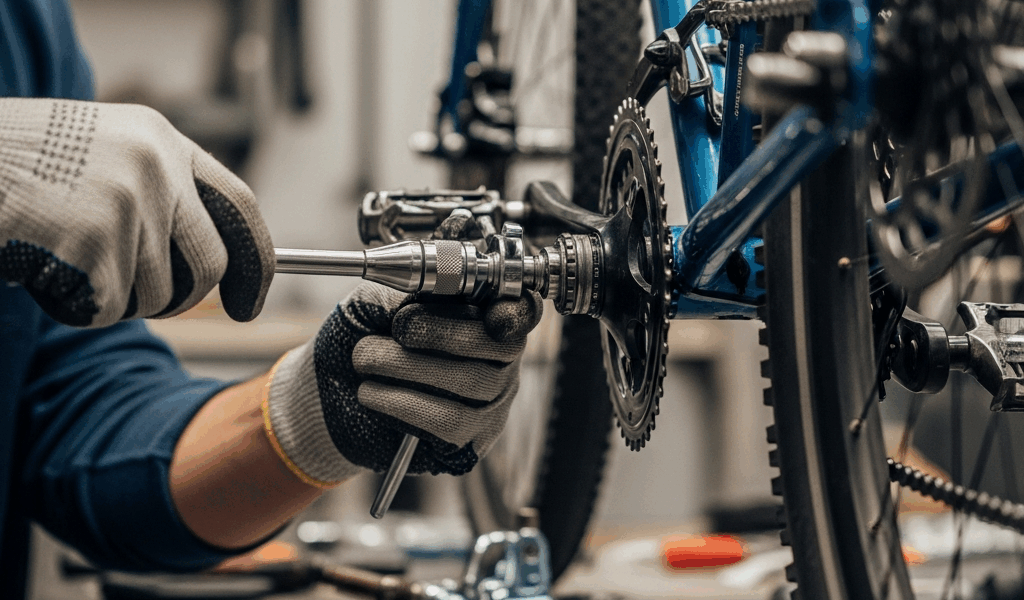
- Remove the cranks. HollowTech II uses the Shimano crank removal tool — TL-FC16 or similar — to back out the plastic preload cap, then the pinch bolts come out and the non-drive crank pulls off.
- Remove the BB cups with the BBT-32. Drive-side cup is left-hand thread — turn clockwise to loosen.
- Clean the frame threads completely. Rag first, then isopropyl alcohol on a cotton swab. Get every groove. Frame thread contamination is the most consistently overlooked step in this whole process.
- Inspect the threads for damage. Cross-threaded or stripped threads need a tap and die set — or a shop with an M33 tap — not a home repair.
- Apply fresh grease. I use Park Tool PPL-1 or Phil Wood Waterproof Grease, a moderate layer covering all thread surfaces. Don’t be stingy, but don’t glob it either.
- Thread the cups in by hand first to confirm clean engagement, then torque to 35 to 50 Nm. Shimano specifies that range for their BSA BBs — I usually land at 42 to 45 Nm.
- Reinstall cranks and test ride.
Worn-out threaded BBs can creak regardless of thread prep quality. If the bearing feels rough when you spin it by hand — gravelly, notchy, catching at specific points — the cups are done. Shimano Ultegra SM-BBR60 runs about $35 and is the benchmark for BSA external bearing replacement. The Shimano 105 RS500 is essentially the same bearing for a few dollars less. First, you should just replace it — at least if you’ve already pulled everything apart anyway.
Press-Fit BB — The Notorious Creaker
Press-fit bottom brackets are genuinely contentious in the cycling world, and they’ve earned every bit of that reputation. The concept is that BB cups press directly into the frame shell without threads — saves a few grams, makes frames slightly easier to manufacture. In practice, they creak. They creak when new. They creak after service. Some of them, apparently, just creak forever.
The standards are chaotic. PF30 uses a 46mm ID shell with 30mm spindle cranks. BB86 — also called PF86 or Shimano PF — uses a 41mm ID shell with 24mm spindle cranks. BB92 is the mountain bike version in a wider shell. BB386EVO tried to be universal and mostly just confused everyone for several years. If you don’t know what you have, measure the shell ID with digital calipers before ordering anything.
Why Press-Fit Creaks
The cups sit in the frame shell under interference fit — the cup is slightly larger than the hole, held in place purely through friction. The problem is that carbon fiber and aluminum don’t maintain that interference fit perfectly under real-world load cycles. The cup micro-moves. That micro-movement is your creak — and it’s maddening.
Grease makes this worse. Grease reduces friction, which is exactly what you don’t want in a press-fit interface. The correct product here is a retaining compound — Loctite 609 might be the best option, as press-fit BB service requires a cylindrical joint retainer specifically. That is because it’s formulated to fill microscopic gaps and cure into a rigid bond under low oxygen conditions, which is precisely what a BB shell provides. A bottle runs $18 to $22 and lasts for years.
Press-Fit Service Procedure
Press-fit removal requires a proper removal tool — a generic bearing press kit with the right adapters works, as does the Park Tool BBP-1, or in a genuine pinch a homemade threaded rod setup. Don’t hammer them out directly. You can damage the shell, and then you have a much larger problem.
- Remove cranks. Remove old BB cups using the appropriate removal tool.
- Clean the shell bore thoroughly — isopropyl alcohol, cotton swabs, remove all old retaining compound or grease residue. The shell needs to be clean and dry for the Loctite to bond properly.
- Inspect the shell bore for damage or scoring. Deep scoring means the interference fit is compromised — some frames need a threaded conversion insert at this point. Wheels Manufacturing makes excellent threaded inserts for most press-fit standards, around $55 to $80.
- Apply Loctite 609 to the outer surface of the BB cups — thin, even film around the full circumference. Apply a thin layer to the shell bore as well.
- Press the cups in squarely using the press tool. Misalignment during pressing is a creak just waiting to happen on the first hard ride.
- Let the Loctite cure for at least 30 minutes before installing cranks. Full cure is 24 hours, but 30 minutes gives enough initial strength for assembly.
Frustrated by recurring press-fit creaks on a customer’s 2019 Specialized Tarmac SL6, I eventually installed a Wheels Manufacturing threaded conversion — a sleeve that threads into the frame and gives a BSA interface. The bike has been silent for two full seasons since. That’s what makes the threaded conversion endearing to us mechanics who’ve fought these press-fit battles: it’s not admitting defeat. It’s just solving the problem properly.
This new approach to press-fit frames took off several years later and eventually evolved into the T47 standard enthusiasts know and appreciate today — a threaded BB with the same 46mm shell diameter as PF30 but with actual threads cut into the frame. Press-fit-sized but threaded. If your frame has it, count yourself lucky and treat it exactly like a BSA threaded BB.
When to Replace Instead of Fix
Cleaning and regreasing a BB is worth doing once. Maybe twice on an older bike with a quality bearing cup. But bearings wear out — there’s a point where service just stops making financial or mechanical sense.
The Bearing Feel Test
With the cranks removed, spin the BB spindle by hand. Good bearings feel smooth with a slight dampness to the rotation — that’s the grease working. Bad bearings feel notchy, gravelly, or rough in a way that catches at specific points in the rotation. Some bearings develop a rumbling quality under load that you can feel through the spindle even without cranks attached.
Apply light lateral pressure to the spindle while spinning. Any side-to-side play — any movement at all perpendicular to the spindle axis — means the bearing is worn past serviceable condition. Replace it. No amount of fresh grease fixes worn races.
Lifespan by Type
Shimano cup-and-cone external bearings like the BBR60 are surprisingly durable when kept greased — I’ve gotten four to five years on a commuter bike out of a single set of cups with regular service. Press-fit bearings tend to wear faster — they’re smaller and harder to seal against contamination. Ceramic bearings from Kogel or CeramicSpeed are genuinely longer-lasting than steel, not just marketing language, but they run $120 to $300 and don’t make sense on every build.
Signs a replacement is overdue: roughness that persists after fresh grease, any lateral play in the spindle, or a creak that returns within a few rides of a full service. A new Shimano threaded BB is $25 to $40. Spending an afternoon re-servicing a dead bearing isn’t frugality — it’s just delay.
One More Thing
If you’ve replaced the BB, regreased the pedals, serviced the seatpost, checked the chainring bolts — and the creak is still there — check your shoes. Cleats work loose. Cleat bolts dry out. A creaking cleat-to-pedal interface happens at exactly the same cadence as a BB creak and it will make you feel like you’re losing your mind. Three-bolt SPD-SL cleats especially. Put some grease under the cleat plate before reinstalling and check those M5 bolts. It’s embarrassing how often that turns out to be the answer — but honestly, it’s always worth checking last.


Stay in the loop
Get the latest adventure cycling world updates delivered to your inbox.