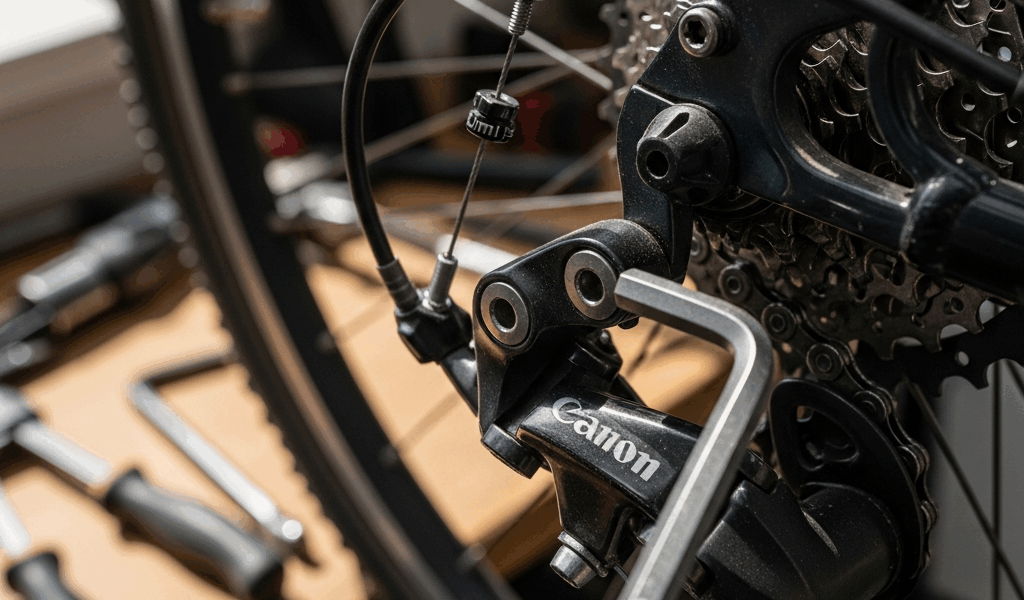
Why Your Rear Derailleur Refuses to Shift Down
Rear derailleur troubleshooting has gotten complicated with all the conflicting advice flying around. So let me cut through it. Your derailleur sits stubbornly in the top cogs, ignoring every downshift command — and there’s a real reason that’s happening, not some mystery gremlin in the drivetrain.
Here’s the mechanical reality: your derailleur runs on cable tension. Click toward lower gears, the cable pulls tighter, derailleur moves inward, chain drops to a smaller cog. Simple chain of events. When it breaks down, you’re dealing with one of exactly two problems — either the cable isn’t pulling hard enough, or something physical is blocking the inward movement. That’s it. Bent hanger, mis-set limit screw, seized pulley, frayed cable — they all live under those two categories. Knowing that keeps you from chasing ghosts around your garage for an hour.
Start Here — Check Cable Tension First
As someone who’s owned three bikes over fifteen years and rebuilt shifters on all of them, I learned that the barrel adjuster solves roughly half of these problems without touching anything else. Today, I’ll share everything I know.
The barrel adjuster is a small threaded cylinder — you’ll find it right where the cable enters the derailleur body. On most derailleurs it points downward or sideways. Stand over the rear wheel and locate it. Finger-tight. That’s how it’ll feel.
Turn it counter-clockwise in quarter-turn increments. Each quarter-turn adds cable tension. Shift down while you turn — the derailleur should start wanting to move inward. Stop when the chain drops crisply to the next smaller cog within a single pedal stroke. That crisp drop is exactly what you’re chasing.
Over-tensioning has its own sound. Grinding, chattering, the chain struggling up into the smallest cog. Heard it myself on a wet Tuesday in April, didn’t know what it was until I’d gone three full turns past where I should’ve stopped. Don’t make my mistake. If you hear that grinding, turn clockwise a half-turn and test again.
Most riders need two or three quarter-turns total. If you’ve already spun the barrel adjuster five or six full rotations and nothing changed? Cable tension isn’t your culprit. Move on.
Inspect the Cable and Housing for Damage
Trapped by rust and trail mud, a cable can jam even when tension looks theoretically fine on paper. I learned this after a rainy October ride left my 2019 Trek Marlin shifting like wet cardboard for two full weeks before I finally looked at the cable itself.
Start where the cable meets the derailleur — specifically, the pinch bolt. The cable should sit cleanly under that single bolt, no fraying, no broken strands. A shredded cable means replacement, full stop. New derailleur cables run $8 to $15 at most shops, or order a Shimano or KMC universal cable online. You can swap it yourself in under 10 minutes with a 5mm Allen wrench.
Then trace the housing — the plastic or metal tube running from shifter to derailleur. Look for:
- Cracks or splits in the plastic coating
- Bent or kinked sections anywhere along the run
- Rust or visible dirt at the housing end caps
A kinked housing binds the cable inside and kills tension regardless of how you adjust the barrel. Bent housing doesn’t un-bend — replace the full housing or a cable-and-housing set. A quality kit from Jagwire or Shimano runs $20 to $40 and comes with everything.
Pull the cable slightly out at the derailleur end and peer into the housing opening. You’re looking for rust, dirt, crusty buildup — anything that would cause friction. A sticky cable inside the housing behaves exactly like low tension, even after multiple barrel adjuster turns. I’m apparently the type of rider who forgets to lube cables for two winters straight, and a light flush with Tri-Flow works for me while WD-40 never really cuts through the gunk. Pull the cable fully, wipe it down with a clean rag, flush the housing with a light machine oil. Most times you’re back to smooth movement in under five minutes.
Check Your Limit Screws and Hanger Alignment
Probably should have opened with this section, honestly. More bikes than I care to count arrive at my workstand with perfectly fine cables and clean housing — but they still won’t shift down because a limit screw is physically blocking the movement.
The low-limit screw — usually marked “L” right on the derailleur body — exists to stop the chain from flying into your spokes. Real purpose, important screw. But when it’s wound too far inward, it blocks downward shifts before the chain ever reaches the smallest cog.
Find the “L” screw. Phillips screwdriver, counter-clockwise, one half-turn. Shift down. Chain drops? You found it. Nothing? Another quarter-turn counter-clockwise, test again. Do not remove the screw entirely — that’s how chains end up wrapped around axles.
The derailleur hanger is the small aluminum tab bolting the derailleur to the frame. A 2-millimeter bend — smaller than you’d notice glancing at the bike — throws off the entire shift sequence. The hanger is supposed to pull inward cleanly with cable tension. Bent outward even slightly, the cable can’t overcome that offset.
Stand directly behind the bike. Look straight down at the derailleur from above. Parallel to the cassette, perfectly vertical — that’s correct. Cocked outward at all? Hanger is bent.
A proper hanger alignment tool runs $60 to $100. That’s overkill for most home mechanics, and a badly bent hanger honestly belongs at a shop. Minor bends sometimes respond to careful lever pressure using a screwdriver as a fulcrum — I’ve corrected a 1mm bend that way on a 2021 Giant Talon. But there’s real risk of snapping the hanger if you push too far. Aluminum doesn’t forgive second chances.
Still Not Shifting? When to Suspect the Derailleur Itself
But what is internal derailleur failure? In essence, it’s mechanical breakdown inside the parallelogram mechanism itself. But it’s much more than just “old derailleur” — three specific components fail most often.
- Worn pivot bolts. These wear smooth over years of use. A loose pivot lets the derailleur float and lose position immediately after a shift instead of holding.
- Damaged pulley wheels. The lower jockey pulley cracks or develops flat spots. When that happens, cable movement through the system stops feeling smooth — it stutters.
- Seized return spring. The spring that pushes the derailleur outward rusts and sticks. That’s what makes it endearing to us when a derailleur snaps back crisply — a healthy spring doing exactly its job.
Pull the derailleur gently inward by hand, no cable tension. Smooth movement? Does it snap back outward cleanly? Rough, gritty, or dead — internal parts have failed.
Repair versus replacement comes down to bike value and derailleur age. A 10-year-old Shimano Altus on a $200 comfort bike? That was $35 new. Replacement makes more sense than rebuilding it. A current-model SRAM GX Eagle on a $1,800 gravel build? A shop rebuild at $75 to $120 is worth the conversation. New mid-range derailleurs run $50 to $150 depending on groupset — a Shimano Deore RD-M5100 sits around $55 and fits most 10 and 11-speed setups.
So, without further ado, here’s the honest summary: cable tension, cable damage, and hanger alignment cover nine out of ten shift-down failures. All three are fixable at home in under 20 minutes with tools most people already own. Start at the barrel adjuster. Check the cable. Eyeball the hanger. Odds are strong you’ll be shifting down smoothly before you’ve finished your second cup of coffee.




Stay in the loop
Get the latest adventure cycling world updates delivered to your inbox.