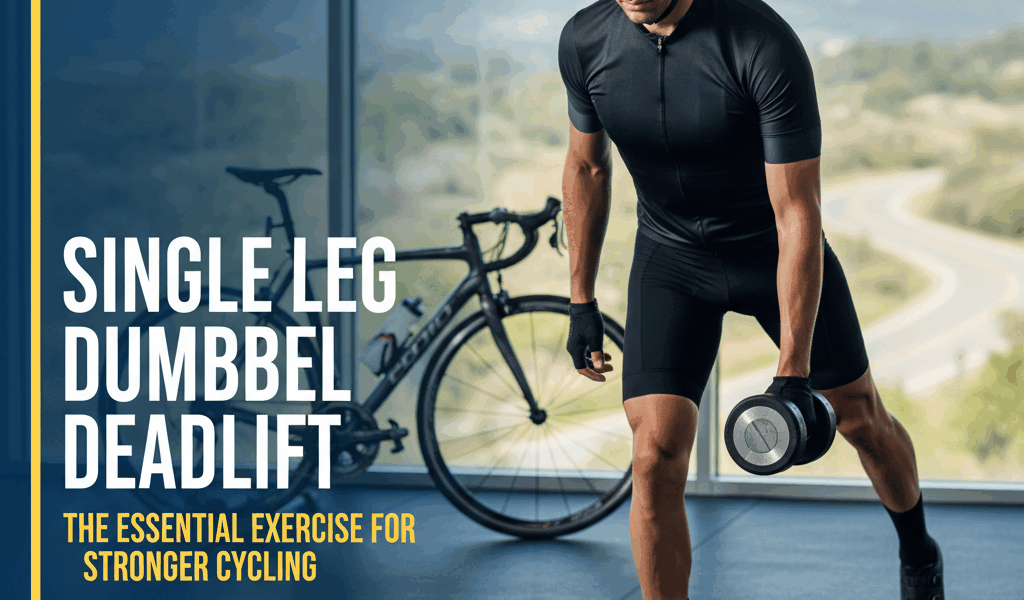
Single leg strength work has gotten complicated with all the exercise variations and “functional training” advice flying around online. As someone who struggled with a 15% power imbalance between my legs for years, I learned everything there is to know about unilateral training the hard way. Today, I’ll share why the single leg dumbbell deadlift is the one exercise that finally fixed my imbalance—and how to do it right.
Probably should have led with this: my power meter showed I was pushing 185 watts with my right leg and only 157 with my left. That’s energy I was leaving on the table every single pedal stroke. Six months of single leg deadlifts brought that gap down to 3%. Nothing else I tried came close.
Why Cyclists Need Single Leg Work
Cycling is inherently a single-leg activity—you’re never pushing with both legs simultaneously. Yet most cyclists train with bilateral exercises like squats and conventional deadlifts, which let the stronger leg compensate for the weaker one. I did this for years and wondered why my imbalance never improved.
That’s what makes single leg deadlifts endearing to us power-focused cyclists—each leg has to work independently with no help from the other side.
Benefits I’ve experienced firsthand:
- Builds hamstring and glute strength for the power phase of pedaling
- Improves hip stability and reduces knee tracking issues
- Develops balance and proprioception (I was terrible at this initially)
- Strengthens the entire posterior chain unilaterally
- Actually addresses left-right power imbalances—not just masks them
Muscles Worked
The single leg deadlift primarily targets:
- Hamstrings: The primary movers, controlling the hip hinge
- Glutes: Stabilize the hip and assist hip extension
- Erector spinae: Maintain spinal position throughout the movement
- Core: Provides stability and prevents rotation
- Ankle stabilizers: Balance on a single leg requires significant ankle work—I had no idea how weak my ankles were until I started these
Proper Form: Step by Step
Starting Position
- Stand on your left leg with a slight bend in the knee (never locked)
- Hold a dumbbell in your right hand (opposite to the standing leg)
- Keep your left arm out slightly for balance or holding a light dumbbell
- Engage your core and pull your shoulders back
The Movement
- Initiate by hinging at the hip, not by bending forward at the waist—this distinction took me weeks to understand
- Push your right leg straight back as your torso lowers
- Keep your hips square—don’t let the floating hip rotate open
- Lower until your torso is roughly parallel to the ground (or as far as flexibility allows)
- The dumbbell should travel straight down, staying close to your standing leg
- Drive through your heel and squeeze your glute to return to standing
Common Form Errors (I Made All of These)
- Rounding the lower back: Keep a neutral spine throughout. I strained my back twice before learning this lesson.
- Letting the hip rotate open: Both hips should face the ground. Film yourself to catch this.
- Bending the standing knee excessively: Maintain a slight bend, not a squat
- Rushing the movement: Control both the lowering and lifting phases
- Looking up: Keep your neck neutral, eyes following the floor
Progressions for Beginners
If you’re new to single leg deadlifts, don’t start with dumbbells. Build the movement pattern first. I wish someone had told me this—I jumped straight to heavy weight and developed terrible habits.
Level 1: Kickstand Deadlift
Keep your rear foot lightly touching the ground behind you for balance. This teaches the hip hinge pattern while providing stability.
Level 2: Bodyweight Single Leg Deadlift
Perform the full movement without weight. Focus on balance and hip hinge mechanics. Master 12-15 controlled reps before adding weight.
Level 3: Light Dumbbell
Start with 10-15 pounds. The weight actually helps by providing a counterbalance. Hold the dumbbell in the opposite hand from your standing leg.
Level 4: Heavier Loading
Progress to challenging weights once form is solid. Many cyclists can work up to 40-60% of their body weight for working sets. I’m at about 55% now.
Programming for Cyclists
In-Season
During heavy riding periods, use single leg deadlifts for maintenance:
- 2 sets of 8-10 reps per leg
- Moderate weight (RPE 6-7)
- Once per week
- At least 48 hours before key rides—I learned this after destroying a Tuesday interval session
Off-Season/Base Building
Build strength when riding volume is lower:
- 3-4 sets of 6-8 reps per leg
- Challenging weight (RPE 8)
- Twice per week
- Progress weight every 1-2 weeks
Variations Worth Trying
Romanian Single Leg Deadlift
Keep the floating leg straighter and focus on hamstring stretch. Less balance demand, more hamstring emphasis.
Contralateral Loading
Hold dumbbells in both hands. More total load, slightly easier balance.
Ipsilateral Loading
Hold the dumbbell on the same side as the standing leg. Increases core anti-rotation demand significantly.
Deficit Single Leg Deadlift
Stand on a small platform (2-4 inches). Increases range of motion and hamstring stretch. Only add this once you’ve mastered the basic version.
Integrating with Your Cycling Training
The single leg deadlift works best as part of a complete lower body routine. Here’s what I actually do:
- Warm-up: 5 minutes easy spinning or walking
- Hip activation: Clamshells, glute bridges (2×15 each)
- Single Leg Deadlifts: 3×8 each leg
- Bulgarian Split Squats: 3×10 each leg
- Copenhagen Planks: 2×30 seconds each side
- Core work: Dead bugs, pallof press
Troubleshooting Balance Issues
If balance is your limiting factor (it was mine for months):
- Practice near a wall or rack you can touch if needed—no shame in this
- Focus your eyes on a fixed point on the floor
- Slow down the movement—speed kills balance
- Strengthen your ankles with separate stability work
- Accept that balance will improve with practice—mine took about six weeks to feel natural
The single leg dumbbell deadlift takes time to master, but the payoff for cyclists is substantial. You’ll develop more balanced power output, reduce injury risk, and build the posterior chain strength that translates directly to stronger climbing and sustained power on the bike. My only regret is not starting these five years earlier.