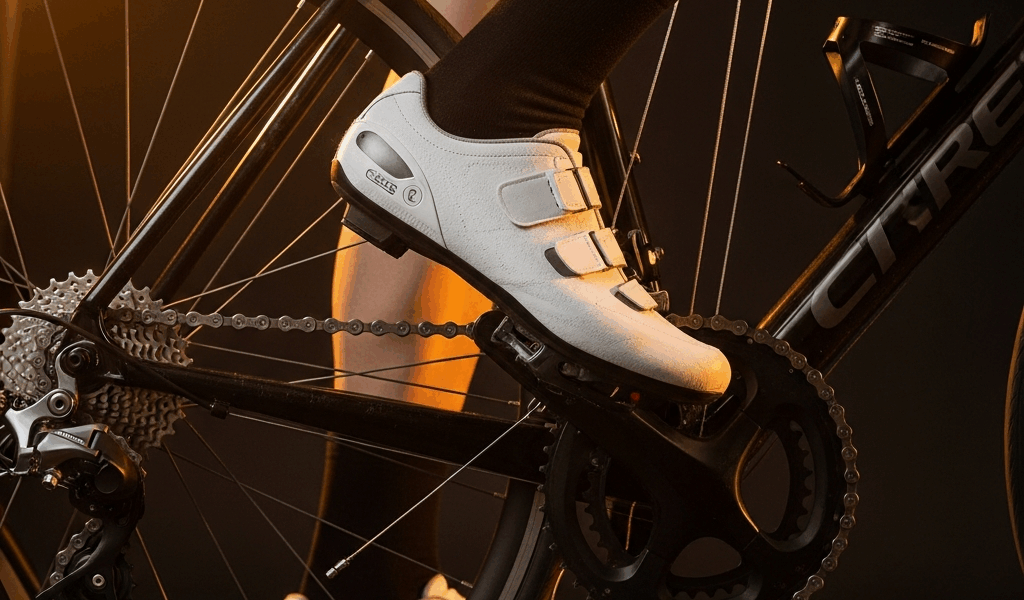
Why Shifting Specifically Triggers Knee Pain
Cycling knee pain has gotten complicated with all the conflicting advice flying around. Saddle height. Cleat float. Bike fit. Everyone’s pointing at something different. But if your knees hurt specifically when you shift — not during long climbs, not after hour three — the problem is almost certainly mechanical, and it’s more fixable than you think.
Here’s what’s actually happening. When you click the lever, the resistance at your pedals changes instantly. Your leg is mid-stroke, still pushing against the old cog’s tension, and suddenly the chain jumps somewhere else entirely. That half-pedal-stroke window where your muscles are working against mismatched resistance? That’s the load spike. The knee absorbs it.
Most articles stop at saddle height and call it a day. That’s not wrong, exactly. Those things matter. But they’re not why shifting hurts. The transition itself is the culprit — that brief, abrupt mismatch between what your leg expects and what the drivetrain delivers.
The distinction is worth spelling out. General cycling knee pain builds slowly. It’s dull, diffuse, and shows up after forty minutes in the saddle. Shifting-specific pain is sharp. Localized. It happens the moment you move the lever and sometimes fades within a few pedal strokes. That specificity is actually useful — it means something mechanical just went wrong, not that your entire fit is broken.
Where it hurts matters too. Medial knee pain — inside of the knee — usually means the patella got yanked sideways during a rough transition. Outside pain points toward how your cleat angle handles lateral stress. The location varies. The trigger doesn’t: a hesitant, delayed, or rough shift that forces your leg through misaligned resistance.
Cable Tension Is Usually the First Culprit
Probably should have opened with this section, honestly. I spent about two riding seasons chalking up knee pain to “just how things are” before a mechanic friend watched me shift and immediately said, “your rear cable is shot.” Adjusted it that afternoon. Next ride, the sharp twinge on upshifts dropped dramatically — I’d estimate 60 percent, maybe more. Two years of unnecessary discomfort, fixed in fifteen minutes with a barrel adjuster.
Stretched or loose derailleur cables create hesitation. The lever moves. The derailleur arm lags behind — maybe half a second, maybe less. Doesn’t sound like much. But you’re still pedaling through that half second, working against the old cog while your brain has already registered the shift. That desynchronization is exactly what produces the sharp twinge.
Checking cable tension takes about three minutes. Find the barrel adjuster — the threaded cylinder where the cable enters the derailleur body. Shift to the smallest rear cog, then pedal slowly while standing still and click through to larger cogs. Clean shifts snap immediately. Sluggish shifts, or ones that require you to feather the lever twice, mean the tension is off. Turn the barrel adjuster counterclockwise a quarter turn. Test again. Most cables need roughly a half turn total before the response feels crisp.
You’ll know when it’s right. The derailleur responds the moment you move the lever — no lag, no hesitation, no load spike at the knee.
If the cable is visibly frayed or corroded, or you genuinely can’t remember the last time it was replaced, just swap it. A Shimano or SRAM replacement cable runs $8 to $15. Shop installation brings the total to maybe $25 to $40. New cables glide through housing with noticeably less friction — that friction is part of what delays shifts on worn setups. Don’t make my mistake. Replace it sooner rather than later.
Gear Ratios and Cadence Habits That Make It Worse
Shifting timing is something most riders never think about consciously. I didn’t. I used to hit climbs and shift mid-effort — chain under maximum load, quads already screaming, derailleur fighting peak tension just to move the chain one cog. That’s a recipe for exactly the kind of sharp knee pain this article is about.
The fix is simple in theory, harder to make automatic: shift before the resistance peaks. Ease off the pedal pressure for one or two strokes — just slightly — then shift. The chain is under less tension. The derailleur moves it cleanly. Your knee experiences a smooth transition instead of an abrupt one. This isn’t some abstract comfort philosophy. It’s just how the mechanics work.
Anticipating terrain matters here. Shift before the climb, not halfway up it. Shift before the headwind section hits. Reading the road thirty seconds ahead and adjusting your gearing proactively keeps your drivetrain out of those peak-tension moments where rough shifts do the most damage.
Cross-chaining is worth addressing separately. Running the big chainring with a large rear cog — or the small ring with a small rear cog — creates extreme cable angles. The derailleur works against geometry, not just chain tension, and shifts become rougher almost automatically. If knee pain flares specifically in those gear combinations, that’s your signal. Shift to a middle chainring before loading those problem combos, or adjust cadence to avoid them entirely.
Cleat and Saddle Position as Hidden Contributors
Cleats and saddle height don’t cause shifting-specific knee pain by themselves. But they amplify it — sometimes significantly. A saddle that’s too low keeps your knee in a compressed angle throughout the entire pedal stroke. Add a rough shift’s load spike to that already-stressed position and the pain gets worse fast. Cleat misalignment does the same thing through a different mechanism: when your foot rotates excessively inward or outward, the knee compensates for that lateral drift on every single stroke, leaving it primed for pain the moment load changes suddenly.
Saddle height check: sit on the bike, place your heel on the pedal at its lowest point. Your leg should be nearly straight — maybe a 25-degree bend at the knee, not much more. More bend than that means the saddle is too low. Raise it in 5mm increments and retest.
Cleat position is trickier to self-diagnose. I’m apparently someone with slight external rotation tendencies, and switching from zero-float cleats to 4-degree float cleats made a noticeable difference — the knee had room to self-align during transitions instead of being locked into a fixed position through them. Zero-float cleats never worked well for me while cleats with some float always did. That said: exhaust the cable tension and cadence fixes first. Don’t overhaul your entire cleat setup before confirming the fundamentals are dialed.
Step by Step Checklist to Diagnose and Fix It
- Check cable tension. Shift through all rear gears while pedaling slowly. Does the chain snap cleanly onto each cog, or does it hesitate? Clean and immediate means you pass. Sluggish or requiring a double-tap means you fail — turn the barrel adjuster counterclockwise a quarter turn and retest. Visibly frayed or corroded cable means replace it entirely. Budget $8 to $15 for the cable, $25 to $40 if the shop installs it.
- Assess your shifting timing habits. Pay attention on your next two or three rides. Are you shifting mid-climb, mid-sprint, mid-effort? That’s the problem. Pass means you’re shifting before resistance peaks — during slightly easier strokes, before terrain changes. Fail means you need to practice anticipating shifts earlier. Takes a few rides to make it automatic.
- Verify saddle height. Heel on pedal at the lowest point, leg nearly straight. Target is roughly 25 degrees of bend at the knee. More bend than that, raise the saddle — 5mm increments only. Less bend, lower it the same way.
- Check cleat alignment. Watch your feet through a few pedal strokes — ideally have someone film you from behind. Feet rotating outward at the bottom of the stroke suggests excessive inward cleat angle. Pass means feet track fairly straight. Fail means rotate cleats outward slightly, or consider switching from zero-float to 4-6 degree float cleats if you haven’t already.
Work through all four checkpoints before drawing conclusions. Most shifting-specific knee pain clears up once cable tension is dialed and cadence timing improves — those two fixes alone handle the majority of cases. If pain persists after everything checks out, a professional bike fit is worth the investment. A fitter can measure knee tracking under actual load and catch things that are genuinely invisible to self-assessment. But start with the cable. It’s almost always the cable.

Stay in the loop
Get the latest adventure cycling world updates delivered to your inbox.